Journal / Wedding Bridal
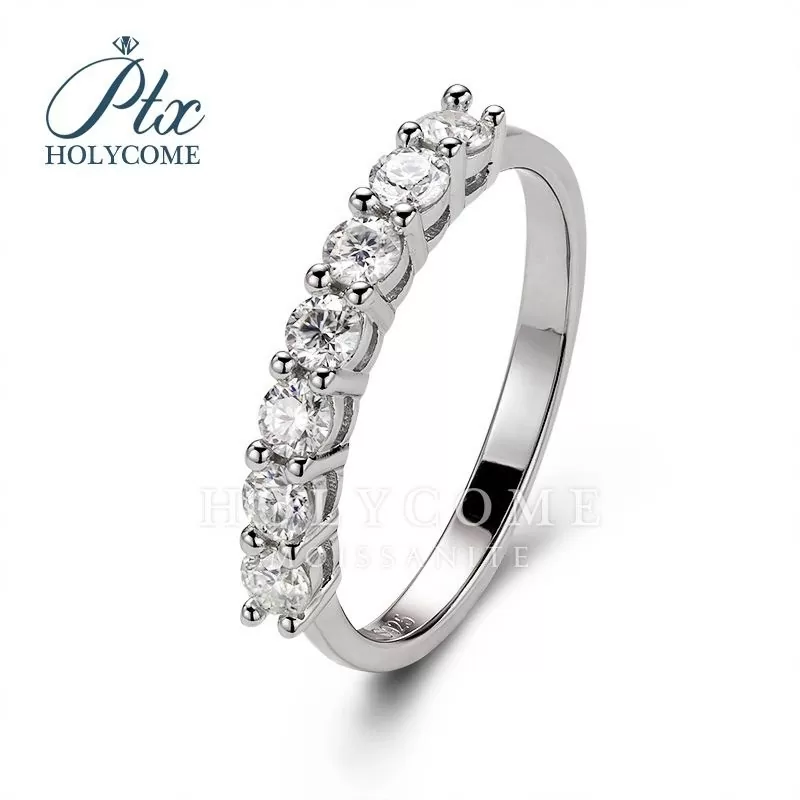
Wedding Band Width and Metal Pairing
A retailer in Seattle sold a 2.2 mm pavé band to pair with a 2.0 mm solitaire and the customer returned it because the two looked unrelated. The widths were close. The problem was the finish: the band was high-polish and the engagement ring was satin, and side by side the difference read as a mismatch.
Pairing is a specification exercise. Four variables decide whether two rings look like a set, and width is only one of them.
[1]The four variables
Width, metal, finish and profile. Get all four aligned and the pair reads as one design. Align three and the fourth becomes the thing the customer notices without being able to name it.
Width
The wedding band is usually the same width as the engagement ring shank or 0.2 to 0.4 mm narrower. A band wider than the engagement ring shank makes the solitaire look undersized, which is the opposite of what the customer intended.
For a 2.0 mm shank, a 1.8 to 2.0 mm band is the safe range. For a 3.0 mm shank, 2.6 to 3.0 mm. The lower end of the range is the choice when the band carries melee, because melee needs a minimum wall either side.
Metal
Matching metal is the default, and mismatching is a deliberate choice rather than a mistake. Two-tone pairs work when the difference is repeated somewhere, such as a white head on a yellow band, so the eye reads it as a design decision.
The metal also decides the service schedule. A white gold pair needs rhodium replating on the same interval, and a pair that is plated on different schedules will drift apart in colour within a year.
Finish
A satin engagement ring with a polished band is the most common pairing failure we see. The fix is either to polish both or to satin both, and the decision belongs at the order stage rather than after the customer has seen them together.
Profile
A comfort-fit engagement ring and a flat-profile band sit differently on the finger and the difference is visible from the side. Match the interior profile as well as the exterior, especially on bands above 4 mm.
[2]Pairing by engagement ring style
The engagement ring's setting decides how much room the band has, and that decides the band's practical width.
| Engagement style | Band width | Constraint | Note |
|---|---|---|---|
| Low solitaire | 1.8-2.2 mm | None | Sits flush, easiest pair |
| High gallery solitaire | 2.0-2.6 mm | Gallery clearance | Band must clear the gallery |
| Halo | 1.8-2.2 mm | Halo edge | Band narrower than halo reads light |
| Three-stone | 2.2-3.0 mm | Side stone height | Curve may be needed |
| Bezel | 2.5-4.0 mm | None | Wider band balances the bezel |
[3]When the band needs a curve
A band that must sit against a setting with side stones usually needs a contour, because a straight band pushes against the side stone and leaves a gap at the base. The contour is cut to the setting's profile, and it is a CAD item rather than a bench adjustment.
Contours add cost because each one is cut for a specific setting. On a volume order that means a contour per engagement ring design, not one contour for the whole range.
[4]Metal colour and the service schedule
Two rings in the same metal need the same care, and two rings in different metals need a schedule that keeps them looking alike. White gold pairs are usually rhodium plated, and the plating wears at a rate that depends on how the ring is worn rather than on its age.
A pair plated on different schedules drifts apart within a year, and the drift is visible because the two rings sit next to each other. Booking both rings for replating at the same interval costs less than replating them separately, and it keeps the colour matched.
Yellow and rose gold pairs
These do not need plating, and their colour is stable. What changes is the surface finish as the ring wears, which shows as a soft sheen rather than a colour shift. A pair refreshed together keeps a consistent finish, which is the visible signal of a set.
Platinum pairs
Platinum develops a patina rather than wearing away, and two platinum rings develop it at different rates if one is worn more. Buyers who want a matched look should plan a light polish on both at the same time rather than polishing one when it looks dull.
[5]Contour or straight: the decision tree
Three questions settle it, and the answers are usually obvious from a side photograph of the engagement ring.
First, does anything project below the shank at the band position? If nothing does, a straight band works. Second, does the band need to sit within 0.3 mm of the setting? If it does not, a straight band with a small gap is acceptable. Third, will the customer wear both every day? If yes, the pair should be checked in a resin trial.
A straight band is cheaper, stronger and resizable. A contour is the answer only when the geometry demands it, and specifying a contour for a ring that does not need one is a cost with no benefit.
[6]What the band should not do
A pairing band should support the engagement ring, not compete with it. Three design choices make a band compete, and all three are visible from across a room.
An accent pattern that runs the full circumference draws attention away from the centre stone. A band wider than the shank makes the centre look smaller. A heavier melee size than the engagement ring's shoulders makes the pair read as two different grades of work.
Where a band can carry its own character
A band can be distinctive without competing when the difference is in texture rather than weight: a milgrain edge, a satin finish, a fine engraved line. Those read as detail at conversation distance and as a matching set when the pair is seen together.
Finger size and the pair
The band and the engagement ring should both be sized for the same finger, and a band worn on the same finger usually needs to be half a size larger than the engagement ring because two rings take more space across the knuckle. That is a fitting decision, and it is worth measuring both rings on the hand rather than assuming the same size works.
[7]What to send us to pair a set
Four items make the pairing decision in one pass: the engagement ring CAD or its measured shank width, the metal and finish, the finger size, and a photograph of the setting from the side.
With those four, we return a band CAD that sits flush, matches the finish and clears the gallery, and we send a resin trial when the pairing is tight enough that a millimetre matters.
[8]Cost and timing
A paired band costs roughly what a band costs, plus a contour charge when the setting requires one. A contoured band adds a CAD round and a casting, which is why pairing a set at the same time as the engagement ring is cheaper than adding a band later.
Minimum order is 50 pieces per design and sizes can be mixed. Sample lead time is around 20 days from approved CAD, bulk 25 to 30 days, and stock designs ship in 15 to 20 days under 500 pieces. Payment is a 30 percent deposit with the balance before shipment, by T/T, PayPal or Western Union, with volume pricing stepping down at 200 and 500 pieces.
[9]Frequently Asked Questions
Should the wedding band be the same width as the engagement ring?
Same or slightly narrower, within 0.4 mm. A wider band makes the engagement ring look smaller, and a band more than 0.4 mm narrower reads as a separate purchase rather than a set.
Can a straight band sit against a halo?
Usually yes, because a halo sits above the shank rather than beside it. The constraint is the halo's outer edge, not its height, so a band up to 2.2 mm sits flush in most cases.
Is a two-tone pair a mistake?
No, if the difference is deliberate and repeated. A white head on a yellow band works when the same contrast appears elsewhere in the design. An accidental mismatch is visible immediately.
Does the band need its own CAD?
For a plain band, no. For a contour, a pavé band or a band that must match a specific profile, yes, and the CAD round is what prevents a gap at the base.
[10]Next step
Send the engagement ring width, metal and finish, and we will quote a matching band with the contour option priced separately. See paired sets in the archive, read the journal on contour fitting, or start a pair on the custom page.