Journal / Ring Size Fit
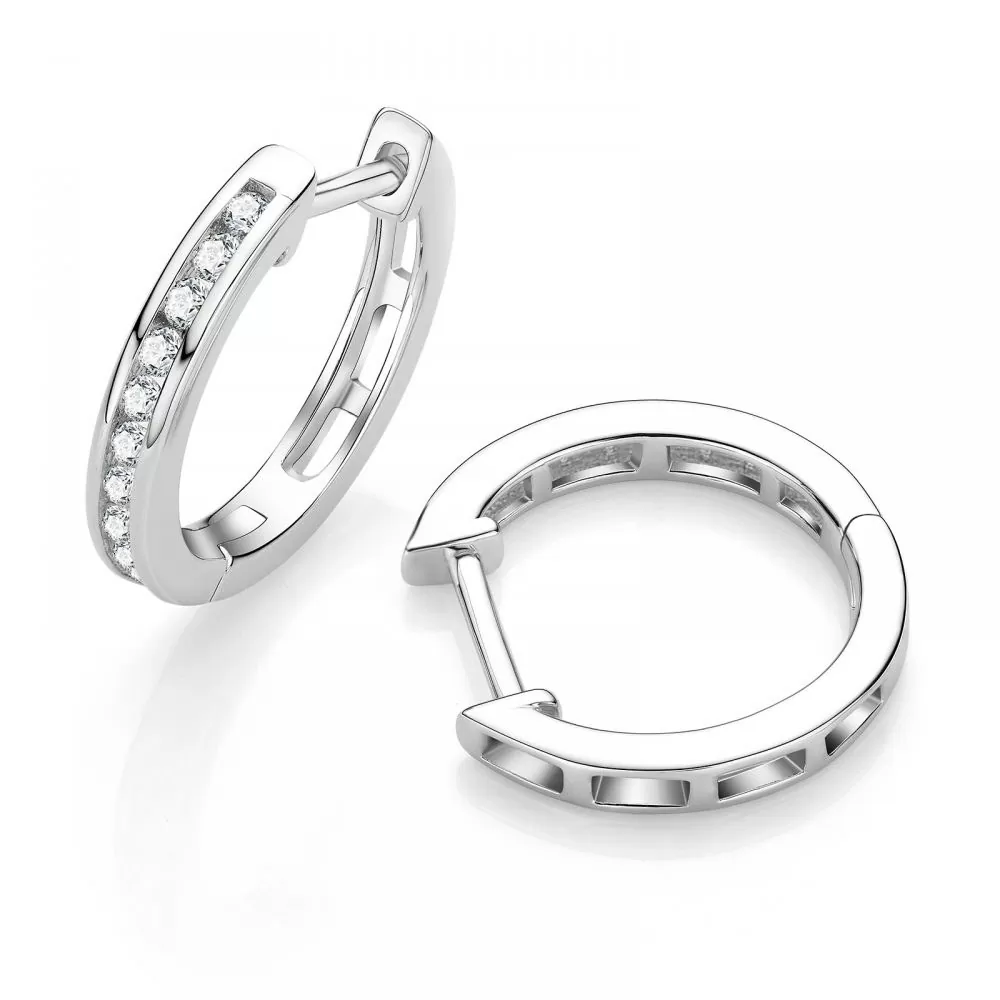
Ring Size Conversion US UK EU Chart
A buyer in Dallas sent us a UK size N and asked for the same ring in a US 7. The two are close but not identical, and on a 2.0 mm band the difference is enough that the finished ring felt loose on the customer's hand. The order was correct against the number that was given and wrong against the finger it was made for.
Size systems are not interchangeable. They measure the same finger in different units, with different rounding and different conventions about whether the size refers to the circumference or the diameter.
[1]What each system actually measures
US sizes are a number scale where each full size is roughly 0.32 mm of internal diameter. UK sizes are letters, and the step between letters is about 0.4 mm. EU sizes are the circumference in millimetres, rounded to the nearest whole number.
Because the step size differs, no single conversion is exact. A conversion chart gives the nearest equivalent, and a nearest equivalent can be half a size off in either direction.
Where the error comes from
Two sources. Rounding, because a circumference of 54.4 mm becomes an EU 54. And the band itself, because an EU size measured on a thin band and used for a 6 mm band will be too small. The size belongs to the ring, not only to the finger.
[2]A working conversion table
The table below is the one we use for order intake. It maps US to UK and EU at half-size resolution, which is the finest step a normal bench can hold.
| US | UK | EU (mm) | Inside dia (mm) |
|---|---|---|---|
| 4 | H | 47 | 14.9 |
| 5 | J 1/2 | 49 | 15.7 |
| 6 | L 1/2 | 52 | 16.5 |
| 7 | N 1/2 | 54 | 17.3 |
| 8 | P 1/2 | 57 | 18.1 |
| 9 | R 1/2 | 59 | 18.9 |
| 10 | T 1/2 | 62 | 19.8 |
Read the table as a starting point rather than a conversion. The inside diameter column is the one that matters at the bench, because it is what the mandrel is set to.
[3]Why a chart is not enough
A chart converts a number. It cannot tell you what the customer measured. Most at-home measurements are taken with a strip of paper or a printed gauge, and both carry error of half a size or more.
The error compounds when the measurement is taken on a cold hand, in the morning, or after the customer has been wearing a ring on the same finger. All three change the result by a fraction of a size, and a fraction is what the chart is trying to resolve.
What to ask for instead
Ask for the inside diameter of a ring that already fits, measured with a caliper, or for a photo of the customer's hand with the existing ring on the finger. A measured diameter removes the conversion step entirely, because every system can be derived from it.
When neither is available, ask for the size in the system the customer actually uses and convert once, at the bench, rather than asking the customer to convert.
[4]Half sizes and the band width problem
US half sizes exist and UK half sizes exist, but they do not align. A US 7.5 is close to a UK O, and an EU 55 sits between them. On a narrow band the difference is tolerable and on a wide band it is not.
Wide bands need a larger size for the same finger because the band covers more of the knuckle and the finger has less room to compress. The adjustment is typically a quarter to half a size for a 4 mm band and a full size for a 8 mm band.
[5]Sizing a ring as a gift
A gift ring carries a size risk that a commissioned ring does not, because the wearer is not present to be measured. The usual workaround is to borrow a ring the person already wears, and the usual failure is that the borrowed ring came from a different finger or a different band width.
The reliable approach is to measure the inside diameter of a ring the person wears on the intended finger, and to ask which finger it goes on. Two questions remove most of the error before any conversion happens.
When the ring cannot be borrowed
Order the ring at the middle of the plausible range and quote a resize at the same time. A plain band resizes cheaply, so a half size of uncertainty on a plain band costs a bench charge rather than a re-run. On a stone-set band the uncertainty is worth resolving before the order is placed.
What not to do
Do not convert a size from a ring worn on a different finger. Fingers differ by up to a full size across one hand, and the conversion inherits that difference without showing it.
A third case is worth naming: a customer who wears several rings on the same finger. The size that works for one ring does not work for a stack, because the stack takes space across the knuckle that a single ring does not. Buyers building a stack should be measured with the stack on the hand or sized up by the combined width.
[6]When to size on the hand instead of the chart
A chart is the right tool for a plain band in a standard width. It is the wrong tool in three cases, and in those the size has to be taken on the hand.
The first is a band above 6 mm, where the width adjustment exceeds what a chart can express. The second is an eternity band, which cannot be corrected later. The third is a customer whose knuckle is much wider than the finger base, where no single size satisfies both.
In each case the answer is a physical fit: a set of wide sizers, a resin print, or a brass trial ring in the actual width. The cost of the trial is a fraction of the cost of a rebuild.
[7]What we do at order intake
We record the size in the customer's own system, the inside diameter if it is known, and the band width. From those three we set the mandrel and state the finished inside diameter on the order sheet.
Where the order is a range, we build the two extremes and confirm the fit before casting the run, because a size that works at 6 does not always work at 9 when the band is wide.
[8]Cost of getting it wrong
A resize is not free and it is not always possible. A plain band resizes for a modest bench charge. A channel-set band may need the channel rebuilt. An eternity band cannot be resized without re-setting the whole line.
On a stock order the error is usually caught at the sample stage, because the sample is one piece and the customer wears it. On a bulk order that skips the sample, the error is caught after 50 rings are finished, and the cost is a re-run rather than a bench charge.
The cost of a wrong size on a single ring is a bench charge plus shipping. On a 50 piece order it is a full re-run, which is why the intake step is worth the ten minutes it takes.
[9]Chart errors that cost a return
Three errors account for most size conversions: a chart that mixes UK letter sizes with US numeric sizes, a chart measured on the inside circumference rather than the inside diameter, and a chart that rounds to half sizes.
The circumference and the diameter are related by pi, so a 1 mm difference in diameter is a 3.1 mm difference in circumference, which is a full size. Charts that quote both numbers without stating which one the size refers to produce returns.
The chart should state the method once, at the top, and use one column for the measurement. A chart with two measurement columns invites the reader to pick the wrong one.
[10]Frequently Asked Questions
Is a US 7 the same as a UK N?
Close but not identical. A US 7 is about 17.3 mm inside diameter and a UK N is about 17.1 mm. The two are within a half size, which is fine on a narrow band and not fine on a wide one.
Can I convert EU to US exactly?
No. EU sizes are rounded to whole millimetres, so several US sizes can map to one EU size. Use the inside diameter to resolve the ambiguity.
Should I order a half size up for a wide band?
Yes, a quarter to a half size for a 4 to 6 mm band and a full size above 8 mm. The band takes space across the knuckle that the finger would otherwise use.
What if the customer only knows their UK size?
Record the UK size as given and convert at the bench using the inside diameter table. Do not ask the customer to convert, because the conversion is the step that introduces the error.
[11]Next step
Send the size in the customer's own system plus the band width, and we will state the finished inside diameter before casting. See sizing rings in the archive, read the journal on wide band fitting, or open an order on the contact page.