Journal / Moissanite Vs Diamond
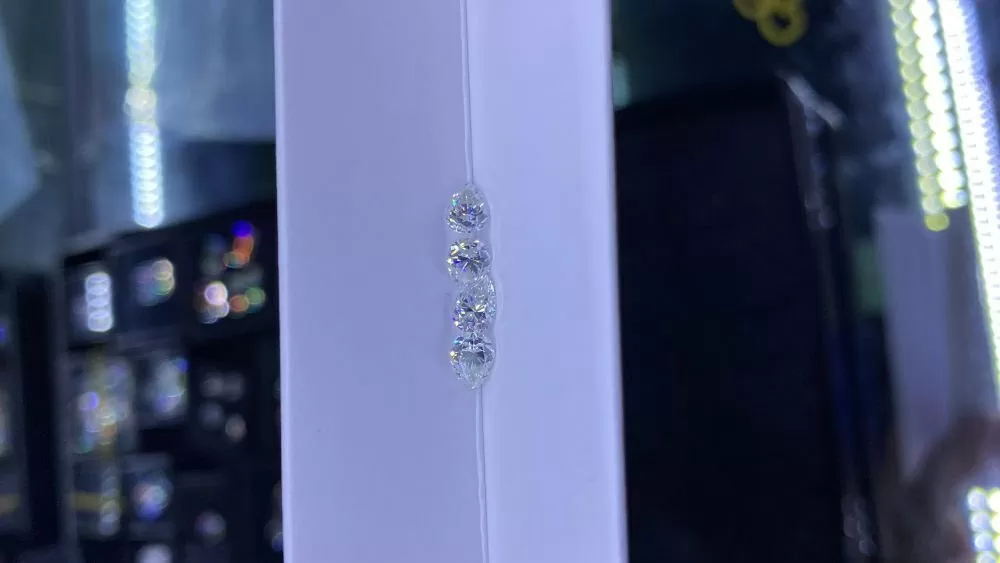
Moissanite vs Lab-Grown Diamond Cost
A buyer in Ohio rebuilt a ring line around lab-grown centres in 2024 and moved the same designs to moissanite for a lower retail tier in 2025. The settings did not change. The metal did not change. The retail price fell by roughly two thirds, and the return rate stayed flat.
That outcome is the exception rather than the rule, and understanding why is the whole question of moissanite against lab-grown diamond at wholesale. The two stones are not interchangeable, and their price gap is not a constant percentage.
[1]What a carat costs in each category
At wholesale, round brilliant moissanite in a colourless grade sits in a range that is low double digits to low double digits-plus per carat, depending on size, cut and source. Lab-grown diamond in comparable colour and clarity sits an order of magnitude higher per carat, and that multiple widens as the stone gets larger.
The two numbers are not comparable line items, because they sit inside different supply chains. Moissanite is manufactured in a small number of facilities and priced as a manufactured product. Lab-grown diamond is traded as a commodity with a published wholesale index, and its price has been falling.
The direction of travel
Lab-grown prices have declined steadily as production capacity expanded, and the decline has been steepest in the 1 ct to 2 ct range where most of the capacity sits. Moissanite prices have been more stable, because the manufacturing base is smaller and the cost structure is different.
The practical consequence is that the gap is narrowing at the large end and holding at the small end. A buyer who modelled the economics two years ago is working from numbers that have moved.
Why per-carat pricing misleads on small stones
Below 0.20 ct, neither stone is priced as a centre stone. Melee moissanite and melee lab-grown diamond are both sold by the parcel, and the price gap compresses because labour and sorting dominate the cost rather than the raw material.
A halo built from 1.2 mm melee costs almost the same in either material once setting time is counted. The savings appear in the centre stone, not in the accent stones.
[2]Where the cost difference actually lands
The price gap is visible on the invoice and invisible on the balance sheet unless the whole cost of ownership is counted. Four lines move in opposite directions.
| Cost line | Moissanite | Lab-grown | Note |
|---|---|---|---|
| Centre stone | Low | High | Gap widens with size |
| Setting labour | Same | Same | Identical bench time |
| Documentation | Rarely graded | Report per stone | Adds cost and admin |
| Returns and claims | Lower expectation | Higher scrutiny | Customer sets the bar |
The documentation line is the one buyers forget. A lab-grown centre stone above 0.30 ct normally ships with a report, and that report is a cost, a lead-time item and an admin task. Moissanite usually ships without individual grading, which removes all three.
[3]When the price difference stops mattering
At retail, a customer choosing between the two is usually choosing a story rather than a spec sheet. Lab-grown diamond carries the diamond category and its resale conventions. Moissanite carries brilliance and a lower price, and it is honest about being neither diamond nor a diamond substitute.
The moment the gap stops mattering is when the customer's budget lands between the two categories. In that band, the decision is driven by what the ring looks like and how it is described, and the buyer's job is to make the description accurate rather than to argue the economics.
Disclosure is the line that cannot move
Every listing must say which stone it is. Moissanite described as diamond, or lab-grown described as natural, is a compliance problem rather than a marketing choice, and the cost of that problem is far above the price difference on any order.
[4]How to run both categories in one catalogue
A catalogue can carry both without confusing customers, if the structure separates them at the category level rather than the product level.
- Separate collection pages for moissanite and lab-grown, not one mixed page
- Stone name in the product title, not buried in the description
- Consistent photography so the two can be compared honestly
- Price tiers that reflect the material rather than the design
- A comparison page that states the difference in plain terms
[5]The metal cost is the constant
Switching the stone does not change the metal, and on many designs the metal is the larger line item. A 14K gold setting at 40 pieces carries a material cost that does not move whether the centre is moissanite or lab-grown diamond.
That matters because buyers often model a material switch as a percentage saving on the whole ring. It is a saving on one line, and the share that line represents falls as the ring gets heavier and more complex.
Where the switch moves the retail price most
A light solitaire in 1 ct is mostly stone by value, so swapping the centre moves the cost dramatically. A three-stone ring with substantial gold and side stones is mostly metal and labour, and the swap moves it less. The design, not the stone, decides how much the switch is worth.
Where the switch changes the design
Some settings are built around the stone's proportions. A step cut in moissanite needs a slightly deeper pavilion to keep the table clean, which changes the shank height and the gallery clearance. The CAD is not identical between the two materials even when the outline is.
[6]How to present the comparison to a retail buyer
A retail buyer comparing the two categories wants three things: a price, a description of what the stone is, and a sense of how the ring will look in five years. A quotation that answers all three is more useful than a specification sheet.
Include the stone name, the warranty terms and the maintenance expectation in the same document as the price. Buyers who receive all three at once rarely come back with a return based on a misunderstanding of the material.
[7]A worked example
Take a 1 ct round solitaire in 14K white gold, 40 pieces, four-prong head, 2.0 mm shank. The stone is the variable, and everything else is held constant.
In moissanite, the centre line is a small fraction of the ring's cost, and the metal plus labour dominate. In lab-grown diamond, the centre line becomes the largest single item and the metal share falls accordingly. The retail price moves by roughly the ratio of the two stone prices, not by the ratio of the two ring prices.
That is the arithmetic buyers miss when they quote a percentage saving. A switch that halves the stone cost does not halve the ring cost, and on a heavy design it may move the total by less than a fifth.
What the example says about positioning
If the ring is light and the stone is large, the material switch is a powerful pricing lever. If the ring is heavy and the stone is modest, the switch is a small adjustment and the design has to carry the price difference instead.
[8]What we quote
We quote both materials on the same design so the comparison is like for like: same CAD, same metal, same setting labour, with the stone line itemised separately. That format makes the real gap visible instead of hiding it in a bundle price.
Minimum order is 50 pieces per design and sizes can be mixed. Sample lead time is around 20 days from approved CAD, bulk 25 to 30 days, and stock designs ship in 15 to 20 days under 500 pieces. Payment is a 30 percent deposit with the balance before shipment, by T/T, PayPal or Western Union, with volume pricing stepping down at 200 and 500 pieces.
[9]Frequently Asked Questions
Is moissanite cheaper because it is lower quality?
No. It is a different material with different optical properties, and it is cheaper because it is manufactured rather than traded as a commodity. Quality within moissanite varies by cut and colour grade, and the top grades are not cheap by any measure.
Will lab-grown prices keep falling?
They have fallen for several years as capacity grew, and no buyer should assume the current level is a floor. Quotations are usually held for a stated period rather than indefinitely, which is why we date every price sheet.
Can I mix moissanite accents with a lab-grown centre?
Yes, and it is a common construction. The two stones sit beside each other without a visible mismatch when the colour grades are matched, and the saving on the accent line is real.
Which holds value better?
Neither holds value in the way a natural diamond is assumed to. Both are manufactured products with a secondary market that is thin, so a purchase should be justified by wear rather than by resale.
[10]Next step
Send a design you already sell, and we will quote it in both materials with the stone separated from the labour. Compare finished pieces in the archive, read the journal on optical differences, or open a quote on the contact page.