Journal / Wedding Bridal
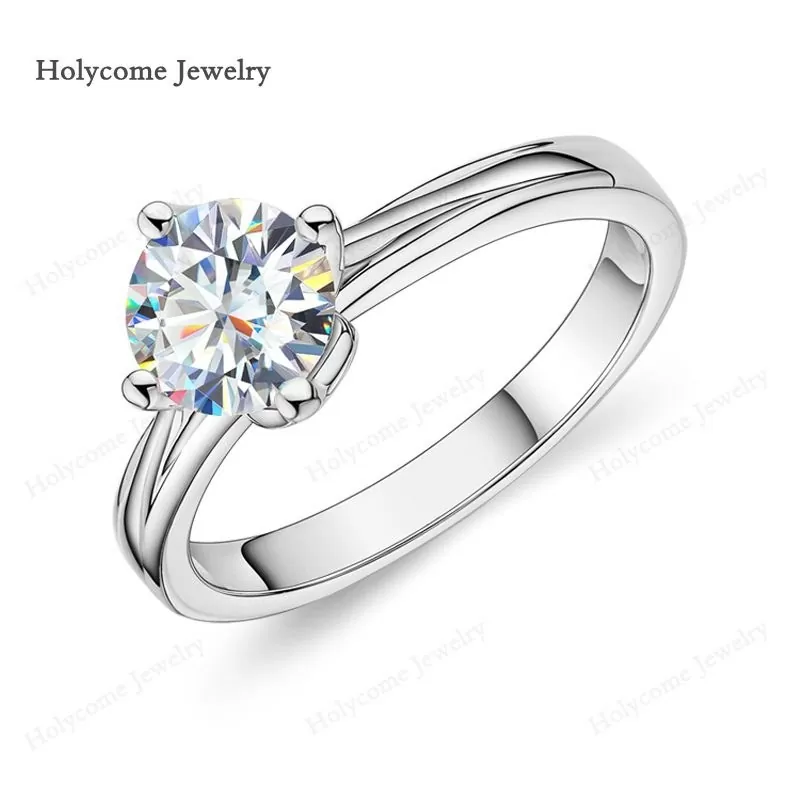
Curved Wedding Bands and Contour Fitting
A customer in Melbourne wanted a straight 2.4 mm band against a three-stone engagement ring. The band sat on top of the side stones, lifted at the base and spun on the finger. The retailer's fix was a thinner band, which solved the clearance and looked wrong against the setting.
The right fix was a contour: a band cut to the shape of the setting so it sits flush without riding up. A contour is not a design compromise. It is the standard solution for any engagement ring with side stones or a low gallery.
[1]When a contour is needed
A straight band works when the engagement ring's shank is plain and the setting sits above it. A contour is needed when something projects below the level of the shank at the point where the band would sit.
- Three-stone rings with side stones lower than the shank
- Halos with a decorative gallery edge
- Low-set bezels where the band would contact the bezel wall
- Rings with a twist or a split shank that crosses the band position
When a contour is not needed
A high-gallery solitaire does not need one, even though it looks like it should. The gallery sits above the band position, so a straight band passes beneath it. Adding a contour to a ring that does not need one adds cost and reduces the band's strength for no benefit.
[2]How a contour is measured
The contour is described by its depth and its span. Depth is how far the band is cut back from its straight line at the deepest point. Span is how wide that cut runs along the band.
On a three-stone ring with side stones 0.4 mm lower than the shank, the depth is typically 0.5 to 0.8 mm and the span 6 to 9 mm. The exact figures come from the setting's profile, not from a standard template.
Where the numbers come from
From the engagement ring's CAD if it exists, and from a measurement of the finished ring if it does not. A measurement taken with a profile gauge at the bench gives the depth and span directly, and it is the only reliable route for a ring that was not made in the same shop.
Why the contour must be a smooth curve
A contour with a sharp corner creates a stress point where the band bends under wear. A smooth curve distributes the load, and it also looks like a design decision rather than a cut-out.
[3]What a contour does to the band
Cutting the band reduces the metal at the contact point, which is exactly where the band takes load from the finger. A contour band needs a slightly heavier shank elsewhere to compensate, usually 0.1 to 0.2 mm added at the base.
| Contour depth | Minimum base wall | Risk if under-specified |
|---|---|---|
| Under 0.5 mm | 1.6 mm | Low |
| 0.5-1.0 mm | 1.8 mm | Bending at the cut |
| 1.0-1.5 mm | 2.0 mm | Cracking under load |
| Above 1.5 mm | 2.2 mm or split design | Structural failure |
Above 1.5 mm depth, a single-piece contour is usually the wrong answer and a split band that passes on either side of the setting is the better one. The split distributes load and keeps the band from becoming a thin bridge.
[4]Checking the pair before casting
A contour is only correct if it clears the setting in the worn position. The check is a resin print of both rings, worn together, with the customer closing their hand and opening it.
Two things show up in the hand that do not show in a render: contact at the contour edge, and rotation of the band when the hand moves. A band that rotates is a band whose contour is too shallow at the edges.
[5]Split bands and when they replace a contour
A split band passes on either side of the setting instead of over it, and it solves the same problem a contour solves without thinning the band at the contact point. It is the better answer whenever the contour would need to be deeper than 1.5 mm.
Split bands cost more because there are two shanks to cast and join, and they are harder to resize. In exchange they keep the metal at the load point and they read as a deliberate design rather than a cut-out.
Where split bands work best
Against three-stone rings, wide cushions and any setting whose side profile is too deep for a single contour. They also work against a ring with a decorative gallery, where a contour would cut into the decoration.
Where they do not
Against a plain solitaire, where the split adds complexity without solving anything. And against a very narrow band, where two shanks at 1.2 mm each are weaker than one at 2.2 mm.
[6]What the customer should know about wear
A contoured band contacts the engagement ring along a short arc, and contact means wear on both surfaces. The wear is slow and it is visible as a polish mark rather than a groove, and it is the normal result of two rings worn together.
Buyers who want to avoid it entirely should accept a slightly larger gap, and buyers who want the pair to read as one piece should accept the mark. The two cannot both be maximised, and the choice belongs to the customer rather than the bench.
On a volume programme the wear question is worth settling in the design brief, because a buyer who promises no contact and then ships a pair that contacts will hear about it. A gap of 0.2 mm is invisible from the top and enough to keep the surfaces apart, which is the compromise most programmes settle on.
[7]Cost and timing
A contour adds a CAD step and, on volume, a per-design tooling charge rather than a per-piece one. The band itself costs slightly more than a straight band because of the added wall and the machining.
Buyers who need several contours across a collection should group them: one assembly file per engagement ring design, with the band contour cut in the same file. Doing it once per design is cheaper than doing it per size, and it also keeps the gap consistent across the range.
[8]How a contour is quoted
A contour is quoted as three lines: the CAD assembly round, the contour cut per design, and the band itself at the heavier wall. On a 50 piece order the first two are fixed charges and the third scales with quantity.
Buyers comparing quotes should compare the three lines separately, because a low band price with a high contour charge is not cheaper than the reverse once the order grows. Asking for the contour as a one-off tooling line makes the comparison honest.
[9]What we produce
We cut contours from the engagement ring's actual profile, state the depth and span on the drawing, add the compensating wall at the base and print a resin pair for fit confirmation. Where the depth exceeds 1.5 mm we quote a split band instead and explain why.
Minimum order is 50 pieces per design and sizes can be mixed. Sample lead time is around 20 days from approved CAD, bulk 25 to 30 days, and stock designs ship in 15 to 20 days under 500 pieces. Payment is a 30 percent deposit with the balance before shipment, by T/T, PayPal or Western Union, with volume pricing at 200 and 500 pieces.
[10]What the trial ring proves
A resin trial proves three things and none of them is visible on a drawing: whether the contour engages the engagement ring without a gap, whether the band sits level across the finger, and whether the gap closes when the hand bends.
A trial that engages at the stone and lifts at the shank will gap in wear, because the finger flexes at the second joint rather than at the base. The trial is the only place that shows up before casting.
The trial also shows the visual line. A contour of 0.4 mm is technically correct and reads as a step; 0.8 mm reads as a curve. The difference is a judgement made in the hand.
[11]Frequently Asked Questions
Can any band be contoured?
Most plain and pavé bands can, provided the wall stays above the minimum for the depth. A channel-set band with a thin wall cannot take a deep contour without losing the channel.
Will a contour band still be resizable?
Usually by one size, less than a straight band. The contour constrains how the band can be cut and rejoined, so buyers should size correctly at the order stage.
Does a contour have to match the setting exactly?
It has to clear it with a small gap. Contact is undesirable because two rings in contact wear each other, so the target is a 0.1 to 0.3 mm gap along the contour.
How long does a contour add to the schedule?
One CAD round, typically three to five days, plus the resin trial if the buyer wants one. The casting and finishing schedule is unchanged.
[12]Next step
Send a side photograph of the engagement ring and its shank width, and we will advise whether a contour or a split band is the right answer. See curved and split designs in the archive, read the journal on set tolerances, or open a brief on the custom page.