Journal / Wedding Bridal
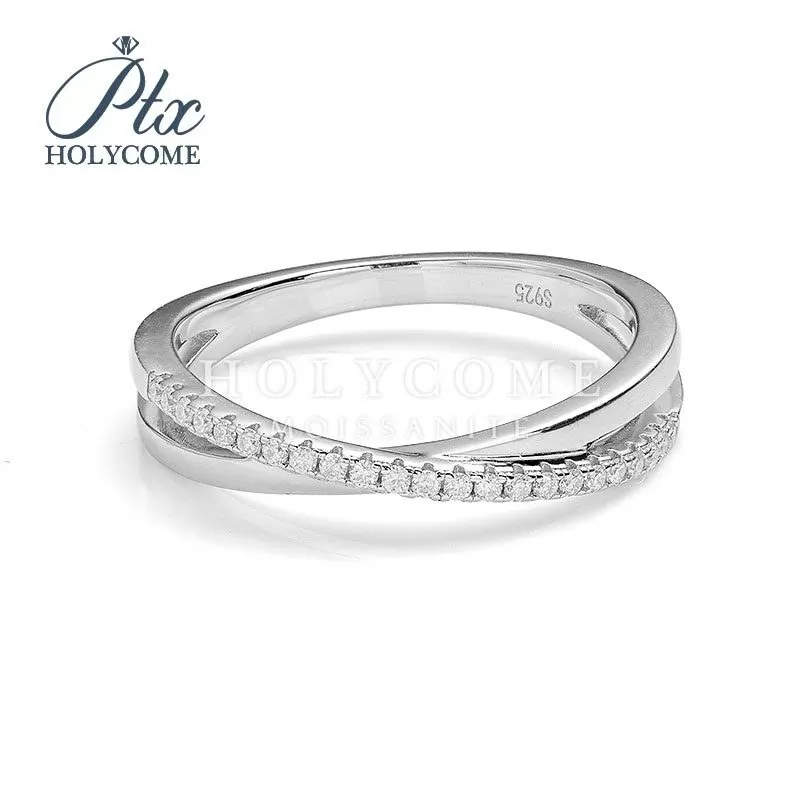
Bridal Set Three Ring Stack Order
A buyer in Phoenix sold 80 three ring bridal stacks with the engagement ring in the middle and had 22 back within a year with worn edges on the two bands beside it. The stack was correct on the hand and wrong in the order.
A three ring stack is a mechanical system as well as a look. The order decides which ring carries the contact wear, and the width decides whether the rings touch at all.
[1]The two orders that work
Engagement ring first from the knuckle, then the wedding band, then the anniversary band. This puts the widest and most detailed ring at the base of the stack, where it is protected by the finger rather than by another band.
The alternative puts the wedding band first and the engagement ring on top, which is the traditional order in some markets. Both arrangements function, and they wear differently, which is the point a buyer should hear before the sale rather than after the first service.
| Order | Wear point | Best for |
|---|---|---|
| Engagement at base | Wedding band edge | Wide engagement ring |
| Wedding band at base | Engagement ring edge | Plain band, detailed ring |
| Bands separated | None | Soft stones, daily wear |
The third row is the arrangement most buyers resist and most repair benches recommend: a gap between the rings removes the contact wear, and a thin spacer band fills the gap without adding meaningful weight to the finger.
[2]Why the middle band wears fastest
Two rings touching a third create two contact points on the middle ring, and each contact point moves with the finger throughout the day. A middle band therefore carries twice the abrasion of the two outer bands, which is why it loses its edge first.
The wear shows as a polished facet on the band's edge, and a facet on a 1.5 mm band becomes a groove within about two years of daily wear. A groove changes the ring's profile permanently and cannot be polished out without removing thickness the band cannot spare.
The width that prevents contact
A total stack width above 12 mm on a size 6 finger starts to bind at the knuckle, and binding produces more contact than any ordering can prevent. Keeping the three bands within 10 to 11 mm total is the practical limit for something worn every day.
A 6 mm engagement ring with two 2 mm bands totals 10 mm, which fits a size 6 hand comfortably. A 7 mm engagement ring with two 3 mm bands totals 13 mm, which binds on most fingers below size 7 and produces exactly the wear the buyer is trying to avoid.
[3]The spacer solution
A spacer is a 1 to 1.5 mm plain band that sits between two rings and takes the contact itself. It is cheaper to replace than either ring it protects, which is the entire argument for including one in a stack.
A spacer with a slight curve follows the engagement ring's contour and removes the gap that a straight spacer leaves at the stone. On a curved engagement ring the spacer has to match the curve, or it will touch at a single point and wear a spot rather than a line.
A spacer in the same metal as the stack reads as part of the design rather than as an accessory, which is why buyers accept it once they understand what it prevents.
[4]Metal hardness in a stack
Two rings of different hardness wear each other unevenly. A platinum band beside a white gold band abrades the gold, because platinum is harder and the gold is softer, and the softer metal gives way at the contact line.
Matching the metal removes the differential. A stack in one metal wears evenly, and a stack in three metals wears at the rate of the softest one, which is the number that decides how often the set comes back for service.
The plating factor
A rhodium plated white gold band loses its plate at the contact point first, which shows as a yellow patch on the edge of the band. That patch is the earliest visible sign of stack wear and it appears well before any groove.
A buyer who sees a yellow edge on a two month old band is looking at a plating failure caused by contact rather than a plating defect. The fix is a spacer and a re-plate, in that order, because a re-plate without a spacer will fail in the same place again.
[5]What the CAD should show
Three items: the stack's total width, the profile of each band's edge, and the clearance between adjacent rings at the contact point. A CAD that shows three rings side by side without those three numbers is a drawing rather than a specification.
The edge profile matters because two flat edges meet along a line and two rounded edges meet at a point. A rounded edge spreads the contact and slows the groove, which is a design change that costs nothing at the modelling stage and cannot be added after casting.
[6]How a stack is sized
A stack is sized as a group rather than as three rings, because the total width changes how the set passes the knuckle. The measurement should be taken with all three rings on the finger at once, using a gauge that represents the full width.
A buyer who measures with one ring and orders three usually ends up a half size small, which is the most common sizing error in the category. The correction is to measure with a wide gauge or to add a half size to the single ring measurement.
[7]What we do
We build the stack as a group, quote the total width against the finger size, recommend a spacer when the total passes 10 mm, and match the metal across the three rings. Buyers who want three metals are told which one will set the service interval.
Minimum order is 50 pieces per design and sizes can be mixed. Sample lead time is around 20 days from approved CAD, bulk 25 to 30 days, and stock designs ship in 15 to 20 days under 500 pieces. Payment is a 30 percent deposit with the balance before shipment, by T/T, PayPal or Western Union, with volume pricing at 200 and 500 pieces.
[8]What a stack looks like after two years
The three visible changes are a facet on the middle band's edge, a yellow line on a plated band's contact point, and a looser fit as the bands thin at the contact. All three are mechanical rather than material failures, and all three are predictable from the total width and the metal match.
A buyer who inspects a stack at twelve months can see all three early enough to add a spacer before the groove forms. A buyer who waits for the two year service finds a groove that cannot be polished out and a band that has to be replaced.
The inspection takes a loupe and two minutes on each edge, and it is the cheapest service interval in the bridal category.
[9]The engagement ring that cannot take a stack
A ring with a high set centre and a thin shank cannot share a finger with two bands, because the shank flexes under the stack's load and the centre sits over the neighbouring rings. The result is a set that looks correct in a photograph and tips in wear.
The fix is a lower centre or a thicker shank, both of which are CAD decisions rather than assembly decisions. A buyer planning a stack from the start should specify the shank for the load rather than for the look alone.
A ring already made with a thin shank can still carry a stack if the spacer is wide enough to spread the contact and the bands are kept under 2 mm each.
[10]Where the metals meet
A platinum and gold stack produces a galvanic difference as well as a hardness difference, because two dissimilar metals in contact with moisture form a small cell and the softer metal corrodes at the contact line.
That corrosion is slow and it leaves a dark line rather than a groove, which is why it is often misread as dirt. A buyer who cleans the line and finds it returns within a week is looking at a galvanic effect rather than a cleaning problem.
Matching the metal, or separating the rings with a plastic or a same metal spacer, removes the cell entirely.
[11]Frequently Asked Questions
Which ring goes on first in a stack?
The engagement ring, so the widest piece sits at the base of the finger. The wedding band goes beside it and the anniversary band outermost.
Why does the middle band wear faster?
It has two contact points instead of one. Each point moves with the finger, so the middle band takes twice the abrasion.
Should I add a spacer band?
Yes when the total stack passes 10 mm, or when one ring is a soft stone. A spacer takes the wear and costs less to replace than either ring.
How wide is too wide for a stack?
Above 12 mm on a size 6 finger the stack binds at the knuckle. Keep the three bands within 10 to 11 mm total for daily wear.
[12]Next step
Send the three ring widths and the finger size, and we will return the total width, the spacer recommendation and the wear point. See bridal work in the archive, read the journal on band contour fitting, or open a brief on the contact page.